Best ai tools for small business
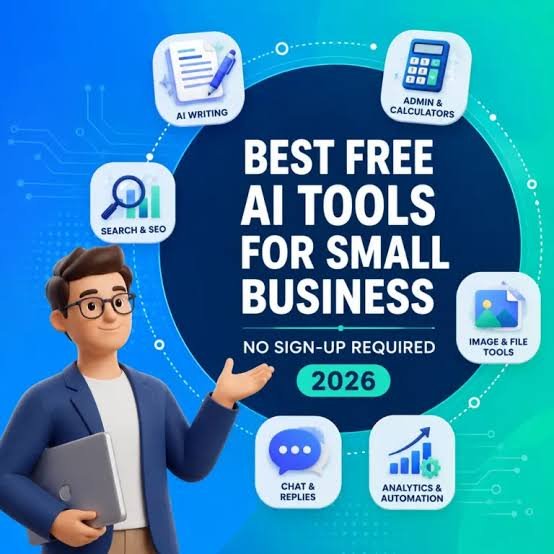
The free AI tools for small business owners can help businesses save time, reduce operating costs, improve customer communication, and attract more customers. Whether you run an online store, a local service company, a marketing agency, or a small startup, artificial intelligence can simplify many daily business activities without requiring a large budget.
Today, business owners can use AI to write marketing content, design promotional graphics, research competitors, organize tasks, and improve customer support. Many platforms offer free plans that allow beginners to explore their features before paying for premium services.
In this article, we will explore seven of the best free AI tools for small businesses, their key features, and how you can use them to improve productivity and grow your business.
Free AI Tools for Small Business Owners: Top 7 Recommendations
Choosing the right AI software depends on your business goals. Some tools are better for marketing, while others help with writing, design, research, and everyday productivity.
Here are seven popular AI tools worth considering.
1. ChatGPT: Best for Business Content and Ideas
ChatGPT is a versatile AI assistant that helps small business owners create content, generate ideas, answer questions, and organize daily tasks.
Instead of spending hours preparing marketing materials, you can use ChatGPT to develop initial drafts and refine them according to your business needs.
Key features:
- Write website content and blog articles.
- Generate social media captions.
- Draft professional emails.
- Brainstorm marketing campaigns.
- Create product descriptions and FAQs.
For example, a local cleaning company can use ChatGPT to draft service descriptions, prepare customer follow-up messages, and generate blog topics related to its services.
ChatGPT offers a free plan with usage limits, while some advanced features require a subscription.
Best for: Small business owners, freelancers, marketers, and entrepreneurs.
Website: https://chatgpt.com/
2. Canva: Best for Marketing Graphics
Canva is a popular graphic design platform that helps businesses create professional-looking visuals without hiring a designer for every project.
Its templates and AI-powered features make it easier to prepare marketing materials for different platforms.
Key features:
- Design social media posts.
- Create promotional flyers.
- Build presentations.
- Prepare advertisements.
- Design banners and business graphics.
For example, a local restaurant can use Canva to create menu graphics, promotional offers, and social media posts featuring its products.
Canva offers a free plan, although some premium templates, assets, and AI features require payment.
Best for: Local businesses, online stores, marketing teams, and startups.
Website: https://www.canva.com/
3. Google Gemini: Best for Research and Planning
Google Gemini is an AI assistant that helps business owners research topics, brainstorm ideas, and organize information.
It can be useful when you need inspiration for marketing campaigns or want to understand your target market better.
Key features:
- Brainstorm business ideas.
- Generate marketing content.
- Summarize information.
- Draft customer communications.
- Assist with research and planning.
For instance, a small landscaping company can use Gemini to brainstorm seasonal promotional ideas, develop service-page outlines, and prepare frequently asked questions for its website.
AI-generated market research should be treated as a starting point rather than proof of customer demand. Verify important claims before making business decisions.
Best for: Entrepreneurs, marketers, and business owners who need research and planning assistance.
Website: https://gemini.google.com/
4. Grammarly: Best for Professional Communication
Grammarly helps businesses improve written communication by identifying grammar mistakes, spelling errors, and unclear sentences.
Clear communication can make emails, website pages, proposals, and customer messages easier to understand.
Key features:
- Check spelling and grammar.
- Improve sentence clarity.
- Suggest writing improvements.
- Help refine professional emails.
- Improve the readability of business documents.
For example, a freelancer can use Grammarly to review a proposal before sending it to a potential client. A small business owner can also use it to polish website content and customer support messages.
Grammarly offers free writing assistance, with advanced features available through paid plans.
Best for: Freelancers, service providers, consultants, and small business teams.
Website: https://www.grammarly.com/
5. HubSpot: Best for Customer Relationship Management
HubSpot offers customer relationship management (CRM) software and marketing tools that help businesses organize customer information and manage sales activities.
Its available free tools can be useful for businesses that want a more organized way to track potential customers.
Key features:
- Organize contact information.
- Track sales opportunities.
- Manage customer interactions.
- Support email marketing workflows.
- Explore available AI-assisted business features.
For example, a small home-service company can use a CRM to organize incoming leads, record customer conversations, and track which prospects need follow-up.
Not every AI feature is free, and some advanced marketing and automation capabilities require paid subscriptions.
Best for: Small businesses that need better lead management and customer organization.
Website: https://www.hubspot.com/
6. Microsoft Copilot: Best for Everyday Business Tasks
Microsoft Copilot is an AI assistant that can help business owners draft documents, brainstorm ideas, summarize information, and solve everyday problems.
It can be a useful addition to a small business workflow when preparing written materials or organizing information.
Key features:
- Draft emails and documents.
- Generate marketing ideas.
- Summarize information.
- Help create task lists.
- Explain unfamiliar business concepts.
For example, a business owner can use Copilot to prepare a meeting agenda, develop an initial marketing plan, or draft a professional response to a customer inquiry.
Some Microsoft 365 integrations and advanced capabilities require eligible subscriptions.
Best for: Small business owners, office workers, and professionals.
Website: https://copilot.microsoft.com/
7. Perplexity: Best for Business Research
Perplexity is an AI-powered research tool that helps users explore questions and find information supported by online sources.
It can help business owners investigate industry trends, learn about competitors, and discover information relevant to their markets.
Key features:
- Research industry topics.
- Explore information with source links.
- Investigate customer questions.
- Discover useful articles and resources.
- Support preliminary competitor research.
For example, a small e-commerce business can research common customer questions about its product category and use those insights to improve its website content.
Always visit the original sources to confirm important information. AI research alone cannot guarantee accurate competitor analysis or reliable market forecasts.
Best for: Entrepreneurs, marketers, and business owners who need research assistance.
Website: https://www.perplexity.ai/
Benefits of Free AI Tools for Small Businesses
AI tools can offer several advantages when used thoughtfully.
1. Reduce operating costs: Free plans provide opportunities to improve workflows without immediately purchasing expensive software.
2. Save time: AI can help create first drafts, generate ideas, and organize information.
3. Improve marketing: Writing and design tools make it easier to produce promotional materials consistently.
4. Enhance customer communication: AI can help prepare clear emails, FAQs, and customer service responses.
5. Support better organization: Research assistants and CRM platforms can help businesses manage information and leads.
However, AI tools do not guarantee higher sales or business growth. Results depend on your strategy, customers, service quality, and how effectively you use the technology.
How to Choose the Right AI Tool for Your Business
Start by identifying your biggest challenge.
- For website content and marketing ideas: Choose ChatGPT.
- For promotional graphics: Try Canva.
- For research and planning: Explore Gemini or Perplexity.
- For professional writing: Use Grammarly.
- For customer and lead management: Consider HubSpot’s free CRM tools.
- For everyday productivity: Explore Microsoft Copilot.
Begin with one or two tools instead of adopting too many platforms at once. Review their free-plan limits, check their privacy policies, and measure whether they save time or improve your workflow.
Avoid uploading confidential customer information unless the platform’s privacy and data-handling arrangements are appropriate for your business.
Conclusion
The free AI tools for small business owners offer practical ways to improve marketing, communication, research, and productivity without a large initial investment.
ChatGPT can help create content, Canva makes graphic design more accessible, and Gemini and Perplexity support research. Grammarly improves written communication, HubSpot helps organize customer relationships, and Microsoft Copilot assists with everyday tasks.
The best tool depends on your business goals and budget. Start with a clear objective, experiment with free features, and evaluate the results before investing in paid software. With the right approach, AI can become a valuable assistant that helps your small business operate more efficiently.
About the Author