Technology is changing how people work, communicate, learn, travel, and manage their daily lives. From artificial intelligence that helps businesses complete tasks to robots that perform complex operations, new innovations are creating opportunities across many industries.
Emerging technologies are not limited to science laboratories or large technology companies. Many are already being used in smartphones, hospitals, schools, factories, homes, and online services.
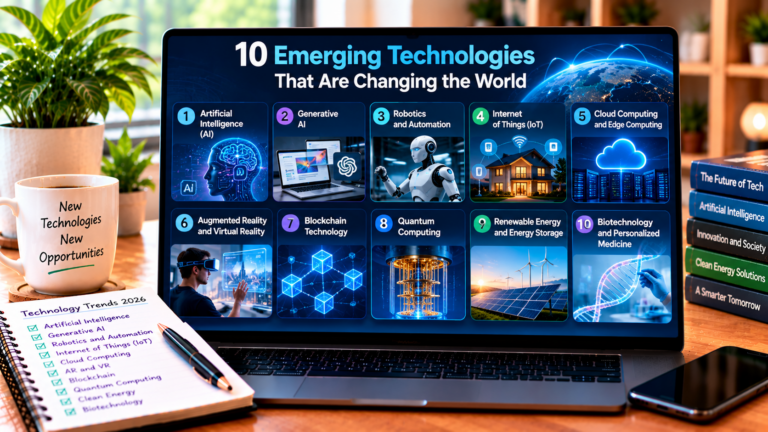
In this guide, we explore 10 emerging technologies, explain how they work, and look at their potential benefits, challenges, and real-world applications.
What Are Emerging Technologies?
Emerging technologies are new or rapidly developing technologies that have the potential to change existing products, services, industries, or ways of working.
Some are still being researched, while others are already available but continue to improve.
Examples include artificial intelligence, quantum computing, advanced robotics, extended reality, and new energy technologies.
Their impact depends on several factors, including cost, reliability, safety, regulation, and how easily people and businesses can adopt them.
1. Artificial Intelligence (AI)
Artificial intelligence is one of the most influential technology fields today. AI systems can analyze information, recognize patterns, generate content, and help people complete tasks that traditionally required significant human effort.
AI is used in many applications, including customer support, translation, fraud detection, medical image analysis, and personalized recommendations.
For example, an online store can use AI to recommend products based on a customer’s browsing activity. A business can use an AI assistant to summarize documents, draft emails, or organize information.
Benefits of AI
- Automates repetitive tasks.
- Helps analyze large amounts of information.
- Supports faster decision-making.
- Enables more personalized digital services.
- Assists people with writing, learning, and research.
Challenges of AI
AI systems can produce incorrect information, reflect biases in their training data, and raise concerns about privacy and employment. Important decisions still require suitable human oversight.
AI is likely to remain an important part of business software, education, healthcare, and digital services as the technology develops.
2. Generative AI
Generative AI is a branch of artificial intelligence that creates new content based on patterns learned from existing data.
It can generate text, images, audio, video, computer code, and other forms of digital content.
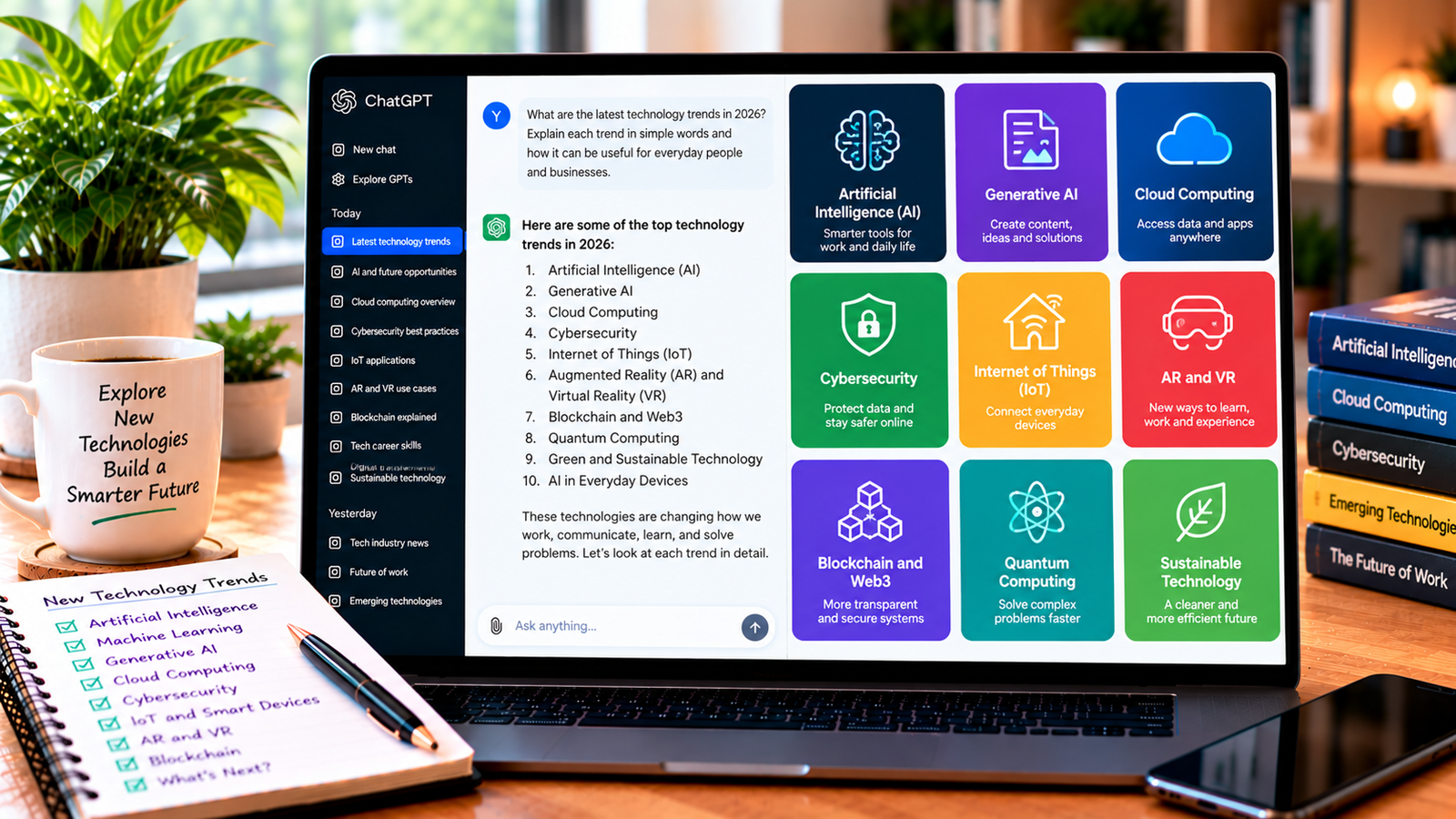
Tools such as ChatGPT help users draft articles, explain difficult concepts, summarize documents, brainstorm ideas, and write code. Image-generation tools can help designers explore visual concepts, while AI coding assistants can support software development.
Where is generative AI used?
- Content creation and editing.
- Graphic design and creative brainstorming.
- Software development.
- Education and personalized learning.
- Marketing and customer communication.
- Video, audio, and media production.
Generative AI can save time, but its output needs review. It may invent facts, produce inaccurate code, or create content that requires editing for quality, originality, and context.
The most useful approach is to treat generative AI as an assistant rather than an unquestionable source of information.
3. Robotics and Automation
Robotics combines mechanical engineering, electronics, sensors, and software to build machines that can perform physical tasks.
Modern robots are used in manufacturing, warehouses, agriculture, healthcare, and research. Some follow carefully programmed instructions, while more advanced systems use sensors and AI to respond to their surroundings.
For example, warehouse robots can move goods between storage areas, while industrial robots can assemble products with high precision.
Applications of robotics
- Manufacturing and assembly.
- Warehouse operations.
- Agricultural monitoring and harvesting.
- Medical assistance and rehabilitation.
- Inspection of dangerous or difficult-to-reach environments.
Robotics can improve consistency and reduce exposure to hazardous work. However, robots require maintenance, careful safety controls, and significant investment in many applications.
As robots become more capable, businesses will need people who can install, operate, program, and maintain these systems.
4. Internet of Things (IoT)
The Internet of Things refers to physical devices connected to networks that collect, send, or receive data.
These devices may include sensors, appliances, industrial equipment, vehicles, and wearable technology.
A smart thermostat, for example, can monitor temperature and adjust heating or cooling according to its settings. In agriculture, soil sensors can help farmers monitor moisture levels and plan irrigation.
Common IoT applications
- Smart homes and connected appliances.
- Industrial equipment monitoring.
- Smart agriculture.
- Vehicle tracking and fleet management.
- Environmental monitoring.
- Health and fitness devices.
IoT can help people monitor conditions and automate routine activities. However, connected devices can introduce security and privacy risks if they use weak passwords, outdated software, or poorly protected networks.
Reliable security updates and responsible data handling are essential for connected technology.
5. Cloud Computing and Edge Computing
Cloud computing allows people and organizations to use computing resources, storage, databases, and software over a network, usually through internet-connected services.
Instead of maintaining every server locally, a business can rent computing capacity from a cloud provider and adjust its resources as needs change.
Edge computing complements this approach by processing data closer to where it is generated, such as on a device, local server, or nearby gateway. This can reduce delays and limit the amount of data that needs to travel to a distant cloud service.
Examples of cloud and edge computing
- Online file storage and collaboration.
- Hosting websites and business applications.
- Streaming video and digital entertainment.
- Processing sensor data in factories.
- Supporting connected vehicles and smart devices.
Cloud services can reduce the need for some on-site infrastructure, while edge computing can help applications that require quick responses.
Organizations still need to consider service costs, internet availability, security, and the risk of depending too heavily on a single provider.
6. Augmented Reality and Virtual Reality
Augmented reality (AR) adds digital information to a view of the real world. Virtual reality (VR) uses technology to create an immersive digital environment.
AR can display directions, labels, or digital objects over a camera view. VR can place users inside a simulated environment for training, education, entertainment, or design.
How these technologies are being used
- Training workers in simulated environments.
- Teaching science and technical subjects.
- Previewing furniture or products in a room.
- Supporting product design and visualization.
- Creating interactive games and experiences.
- Helping professionals practice selected procedures.
AR and VR can make certain learning and visualization tasks more interactive. However, adoption depends on device cost, comfort, accessibility, and the quality of the experience.
These technologies are especially useful when visualizing a space or practicing a task would otherwise be difficult, expensive, or risky.
7. Blockchain Technology
Blockchain is a type of digital ledger that records information in linked blocks according to a defined system of rules.
Some blockchain networks allow multiple participants to maintain and verify records without relying on one central database administrator. Different blockchain systems use different approaches to security, governance, and transaction processing.
Blockchain became widely known through cryptocurrencies, but the underlying technology can also be explored for digital asset management, traceability, and shared recordkeeping.
Potential applications
- Cryptocurrency transactions.
- Tracking selected goods through supply chains.
- Recording certain digital ownership claims.
- Shared records between organizations.
- Automated transactions through smart contracts.
Blockchain is not automatically better than a conventional database. It can introduce challenges involving transaction speed, cost, privacy, regulation, and the correction of inaccurate information.
A project should use blockchain only when its specific benefits justify the additional complexity.
8. Quantum Computing
Quantum computing is a developing field that uses principles of quantum physics to process information in ways that differ from conventional computers.
Traditional computers use bits represented as zero or one. Quantum computers use quantum bits, called qubits, which can use quantum states and interactions to perform certain specialized computations.
Researchers are investigating whether quantum computers can help solve particular problems in chemistry, materials science, optimization, and other fields.
Why does quantum computing matter?
Potential applications include:
- Studying molecular behavior for scientific research.
- Investigating new materials.
- Exploring certain optimization problems.
- Advancing research into quantum physics.
- Assessing future cryptographic risks and methods.
Quantum computing is not a replacement for ordinary computers for everyday tasks. Today’s quantum systems face significant technical challenges, including noise, error correction, and scaling.
Its broader impact will depend on whether researchers can build reliable systems that provide practical advantages for specific problems.
9. Renewable Energy and Energy Storage
Clean energy technology is developing as countries, businesses, and households look for ways to reduce emissions and improve energy security.
Solar panels, wind turbines, battery storage, smart electricity networks, and improved energy management systems all contribute to this field.
Battery technology is particularly important because renewable sources such as solar and wind do not produce the same amount of electricity at every moment. Storage can help move energy from periods of high production to periods of higher demand.
Examples of clean energy innovation
- More efficient solar panels.
- Wind power systems.
- Home and grid-scale battery storage.
- Smart electricity meters and energy management.
- Electric vehicle charging infrastructure.
- Better systems for monitoring energy consumption.
These technologies can reduce reliance on fossil fuels when supported by suitable infrastructure and energy policies. Challenges include installation costs, material supply, recycling, grid upgrades, and differences in local conditions.
Progress in storage and grid management can help make electricity systems more flexible and reliable.
10. Biotechnology and Personalized Medicine
Biotechnology uses biological systems, organisms, or biological processes to develop products and solve problems. It has applications in medicine, agriculture, food production, and scientific research.
Advances in genetic analysis, laboratory technology, and data processing are helping researchers investigate diseases and explore treatments tailored to particular biological characteristics.
Personalized medicine aims to use relevant information about a person, such as genetic or clinical data, to guide selected prevention, diagnosis, or treatment decisions.
Applications of biotechnology
- Developing and improving medicines.
- Genetic testing for certain conditions.
- Research into targeted treatments.
- Improving agricultural crops.
- Developing diagnostic tools.
- Studying disease mechanisms.
These technologies can offer important medical and scientific benefits, but they also raise questions about privacy, affordability, equitable access, safety, and ethical oversight.
Medical decisions should be made with qualified healthcare professionals, using appropriate clinical evidence rather than relying on technology alone.
How Emerging Technologies Are Changing Businesses
Emerging technologies are affecting more than individual products. They are changing how organizations operate and compete.
For example:
- Retail: AI-powered recommendations and automated inventory monitoring.
- Education: Digital learning platforms and AI-supported study tools.
- Healthcare: Advanced diagnostic support and connected monitoring devices.
- Manufacturing: Robotics, predictive maintenance, and automated quality checks.
- Agriculture: Sensors, precision irrigation, and data-driven crop management.
- Transportation: Connected vehicles, route optimization, and new driver-assistance systems.
Successful adoption requires more than buying new software or equipment. Organizations must identify a real problem, assess the costs and risks, train their employees, and measure whether the technology delivers useful results.
Skills to Learn for the Future of Technology
You do not need to become an expert in every emerging technology. The right skills depend on your career interests and the opportunities available in your industry.
Useful starting points include:
- AI literacy: Understanding AI tools, their limitations, and responsible use.
- Data analysis: Learning spreadsheets, statistics, and data visualization.
- Programming: Building a foundation in Python or another relevant language.
- Cybersecurity awareness: Understanding passwords, access controls, and digital threats.
- Cloud fundamentals: Learning how online computing and storage services work.
- Critical thinking: Evaluating information, testing assumptions, and checking results.
- Communication: Explaining technical ideas clearly to nontechnical audiences.
Start with one area that matches your goals. Build small projects, practice consistently, and use reputable learning resources to develop practical experience.
Challenges and Risks of Emerging Technologies
New technology can create valuable opportunities, but adoption also brings challenges.
Privacy and security: Connected devices and digital services may collect sensitive information. Organizations need appropriate safeguards and clear data practices.
Skills gaps: Workers may need training to adapt as job responsibilities and tools change.
Cost and access: Some technologies remain expensive or require infrastructure that is not available everywhere.
Reliability: New systems may make errors or fail in unexpected situations. Testing and human oversight remain important.
Ethical and environmental concerns: Technology can affect fairness, employment, resource consumption, and the environment.
A balanced approach considers both the potential benefits and the possible harms before adopting a new system.
Frequently Asked Questions
What are the most important emerging technologies?
Artificial intelligence, generative AI, robotics, cloud and edge computing, IoT, biotechnology, clean energy, and quantum computing are important areas of development. Their importance varies by industry and by how quickly practical applications mature.
Which new technologies are useful for beginners to learn?
AI tools, data analysis, basic programming, cloud fundamentals, and cybersecurity awareness are accessible starting points for many learners. Choose based on your interests and career goals.
Will emerging technologies replace human jobs?
Some tasks may be automated, while new roles and responsibilities may also develop. The effects differ across industries, occupations, and regions. Learning to work effectively with technology can help people adapt, but outcomes are not guaranteed.
Is quantum computing already used in everyday life?
Quantum computing is still developing and is mainly used in research and specialized experimentation. It is not a general replacement for the computers people use for everyday work.
How can businesses choose the right new technology?
Businesses should start by identifying a specific problem, evaluating available solutions, comparing costs and risks, running a small pilot where appropriate, and measuring the results before expanding adoption.
Final Thoughts
Emerging technologies are reshaping how people work, communicate, learn, and solve problems. Artificial intelligence, robotics, connected devices, clean energy, biotechnology, and other innovations offer opportunities, but each comes with limitations and challenges.
The best way to understand new technology is to look beyond the headlines. Learn how it works, identify the problems it can realistically solve, and evaluate its costs, risks, and practical value.
Follow TechLabMind.com for more guides on new technologies, AI tools, software, and digital skills that can help you understand the changing technology landscape.
About the Author