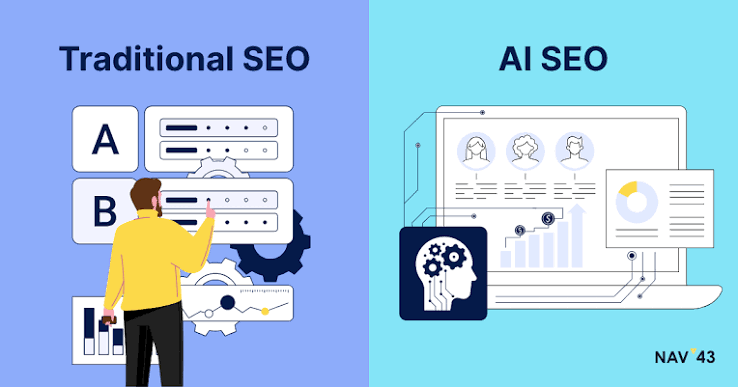
Difference between Traditional SEO and AI SEO is an important topic for businesses, digital marketers, website owners, and content creators who want to improve their online visibility. As search engines and artificial intelligence continue to change how people discover information, understanding both strategies has become essential. Traditional SEO focuses on improving website rankings in search engine results, while AI SEO focuses on making content visible, understandable, and useful across AI-powered search platforms and answer engines.
Both approaches aim to attract the right audience, increase website traffic, and build online authority. However, they use different techniques to achieve these goals. In this article, we will explore their key differences, benefits, and expert-recommended practices to help you choose the right strategy for your business.
What Is Traditional SEO?
Traditional Search Engine Optimization (SEO) is the process of optimizing a website to improve its visibility in search engines such as Google and Bing. Its primary goal is to help web pages appear higher in organic search results when users search for relevant keywords.
Traditional SEO uses several techniques, including:
- Keyword Research: Finding relevant search terms that potential customers use.
- On-Page SEO: Optimizing page titles, meta descriptions, headings, images, and content.
- Technical SEO: Improving website speed, mobile responsiveness, indexing, and site structure.
- Off-Page SEO: Building high-quality backlinks and improving website authority.
- Content Optimization: Publishing informative, relevant, and keyword-focused content.
For example, if someone searches for “best nutrition tips for healthy living,” traditional SEO helps a website optimize its content to appear in Google’s organic search results.
What Is AI SEO?
AI SEO refers to optimizing digital content for discovery through artificial intelligence-powered search experiences, including AI-generated answers, conversational search, and answer engines.
Unlike traditional SEO, which primarily focuses on ranking web pages, AI SEO also aims to make information easy for AI systems to understand, evaluate, and reference when generating answers.
AI SEO commonly involves:
- Creating clear, accurate, and well-structured content.
- Answering specific questions directly.
- Demonstrating expertise and subject-matter authority.
- Using relevant entities, context, and natural language.
- Keeping information accurate and up to date.
- Building a trustworthy online presence across relevant platforms.
For example, when someone asks an AI assistant, “What are the best nutrition habits for overall well-being?”, AI SEO helps make trustworthy information easier for AI systems to identify and potentially reference.
Difference Between Traditional SEO and AI SEO: Key Differences
Although both strategies aim to improve online visibility, their approaches, content requirements, and performance measurements are different.
| Factors | Traditional SEO | AI SEO |
|---|---|---|
| Main goal | Rank higher in search results | Appear in AI-generated answers |
| Keyword strategy | Focuses on target keywords | Focuses on topics, context, and search intent |
| Content style | Keyword-optimized web pages | Clear, informative, conversational content |
| Visibility | Google and Bing search results | ChatGPT, Gemini, Perplexity, and AI search |
| User behavior | Clicking on search results | Asking questions and receiving summarized answers |
| Authority | Backlinks and website credibility | Expertise, trust, and reliable information |
| Optimization | Technical, on-page, and off-page SEO | SEO fundamentals plus AI-friendly information |
| Measurement | Rankings, clicks, and organic traffic | AI mentions, citations, referrals, and visibility |
The biggest difference is that traditional SEO concentrates on helping a website rank, whereas AI SEO also focuses on helping information become a useful source for AI-generated responses.
Which Is Better: Traditional SEO or AI SEO?
Choosing between traditional SEO and AI SEO depends on your business goals, audience, and marketing strategy. However, using both approaches together is generally the strongest option.
Traditional SEO remains valuable because people continue to use search engines to discover websites, compare services, and research products. AI SEO creates additional opportunities for businesses to reach people who prefer conversational answers and AI-powered recommendations.
For example, a website publishing nutrition and well-being content can use traditional SEO to rank for searches such as “best healthy eating tips.” At the same time, it can use AI SEO principles to provide trustworthy, expert-supported answers to questions about balanced diets, healthy habits, and nutritional choices.
Combining both approaches helps businesses reach users at different stages of their search journey.
Best Strategies to Improve Traditional SEO and AI SEO
If you want your website to perform well in both traditional and AI-powered search experiences, consider following these expert-recommended practices:
1. Focus on High-Quality Content
Create original, informative, and valuable content that answers your audience’s questions. Avoid publishing content simply to insert keywords. Your articles should provide practical information, useful examples, and reliable recommendations.
2. Understand Search Intent
Identify what people actually want when they search online. Some users want general information, while others are looking for expert advice, product comparisons, or top-rated recommendations. Create content that matches these different search intentions.
3. Use Relevant Keywords Naturally
Research primary and secondary keywords and include them naturally in your headings, introductions, meta descriptions, and body content. Also use related terms and conversational phrases to provide better topical coverage.
4. Build Website Authority
Publish expert-supported information, earn relevant backlinks, demonstrate experience, and maintain consistent business information across trusted platforms. These activities help establish credibility.
5. Improve Technical SEO
Make sure your website is mobile-friendly, fast-loading, secure, and easy for search engines to crawl and index. Use descriptive URLs, internal links, and appropriate structured data.
6. Answer Questions Clearly
Use descriptive headings, short paragraphs, informative explanations, and frequently asked questions. Direct answers make your content easier for readers to understand and can help AI systems identify relevant information.
7. Keep Content Updated
Review older articles regularly to correct outdated information, add useful insights, and maintain accuracy. When discussing health, nutrition, or well-being, use credible sources and qualified expertise.
Google’s official guidance confirms that traditional SEO fundamentals remain important for its AI-powered search features. It also emphasizes original, helpful, trustworthy, people-first content rather than special AI ranking tricks.
Google for Developers
+2
Future of Traditional SEO and AI SEO
The future of digital marketing will likely involve a combination of traditional search engine optimization and AI-powered discovery. As users increasingly ask complex questions through conversational search tools, businesses will need to provide more meaningful, accurate, and comprehensive information.
Traditional SEO will continue to support website rankings, technical performance, and organic traffic. Meanwhile, AI SEO will help businesses improve their visibility in AI-generated answers and recommendations.
Companies that invest in high-quality content, website authority, user experience, and relevant optimization practices will be better positioned to adapt to these changes. However, no SEO strategy can guarantee first-page rankings or AI citations.
Conclusion
Understanding the Difference Between Traditional SEO and AI SEO is essential for businesses that want to succeed in the changing digital landscape. Traditional SEO focuses on improving organic search rankings, while AI SEO expands visibility into AI-powered search experiences and generated answers.
Neither approach needs to replace the other. Instead, businesses should combine traditional SEO techniques with AI-focused content strategies to reach a wider audience, build trust, and create sustainable online growth. The most effective strategy is to prioritize useful, original, and reliable content that serves real users, regardless of how they search for information.
Suggested SEO details
- Focus keyword: Difference Between Traditional SEO and AI SEO
- SEO title: Difference Between Traditional SEO and AI SEO: Key Differences
- Meta description: Discover the difference between traditional SEO and AI SEO, their benefits, key strategies, and how to improve your website visibility in search engines and AI-powered platforms.
- Search intent: Informational
- Suggested URL slug:
difference-between-traditional-seo-and-ai-seo
Recommended reference: Google’s Official Guide to Optimizing for Generative AI Search .
About the Author