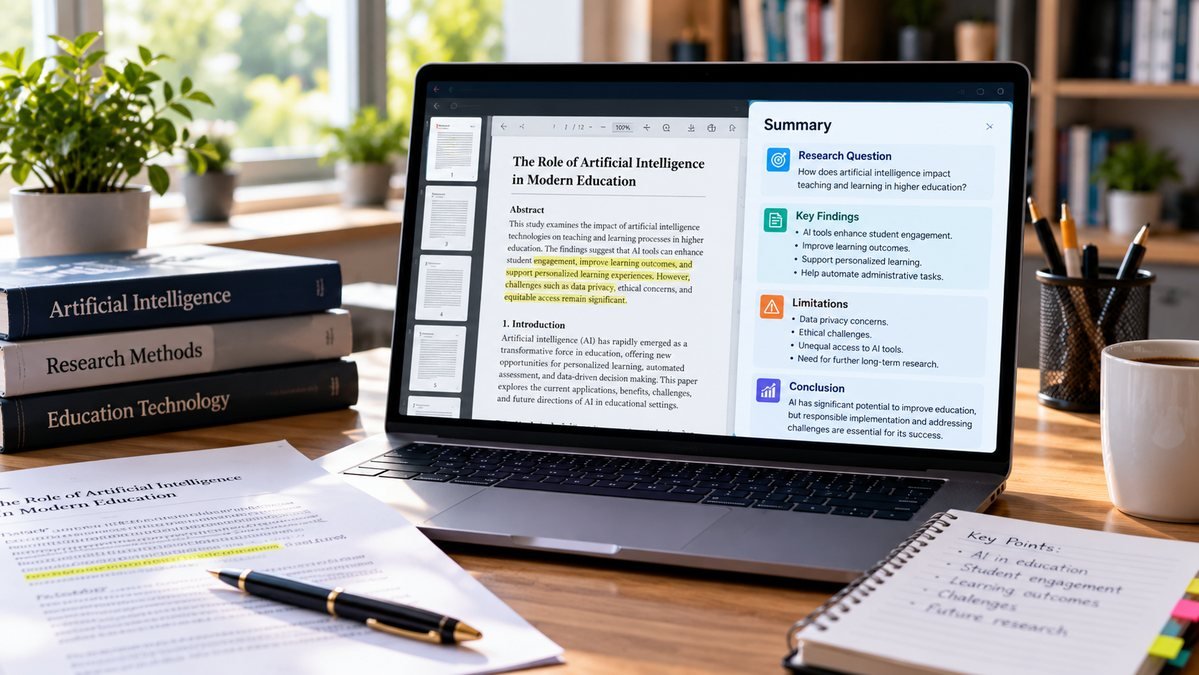
Research papers often contain dozens of pages of background information, technical terms, data, and references. If you’re trying to understand several studies for a class, project, or literature review, reading every paper in full can take a lot of time.
AI tools can make the first reading easier. They can help you identify the research question, understand the methods, pull out the main findings, and spot limitations that deserve closer attention.
The important part is knowing what to ask and checking the answers against the original paper. Here’s how to summarize a research paper with AI without losing the details that matter.
Can AI summarize a research paper?
Yes. AI tools such as ChatGPT can summarize uploaded research papers, explain technical language, organize findings, and answer questions about a study. ChatGPT supports document uploads in supported experiences, subject to file and account limits.
However, a summary is not a substitute for evaluating the research yourself. AI can overlook a qualification, misinterpret a result, or present a finding more confidently than the paper supports.
For academic work, use AI to help you understand the source, not to replace reading the important sections.
How to summarize a research paper with AI
Step 1: Choose the research paper
Start with the paper you need to understand. You can often download it as a PDF from a journal website, university repository, or the author’s publication page.
Before uploading it, check that you have the correct version and that the text is readable. A searchable PDF is usually easier to process than a poor-quality scan.
If you are reviewing several papers, work through them individually first. This makes it easier to keep each study’s findings and limitations separate.
Step 2: Upload the PDF to ChatGPT
Open ChatGPT and start a conversation. Use the attachment option to select your research paper.
Wait for the file to finish uploading, then ask ChatGPT to summarize it.
If you need more detailed instructions for uploading a document, see our guide on how to summarize a PDF with ChatGPT.
If the upload fails, check your account’s current file limits and try a smaller or searchable version of the document.
Step 3: Identify the research question
Before asking for a general summary, find out what the researchers were actually trying to investigate.
Use this prompt:
Read the attached research paper and identify its main research question, research objective, and hypothesis, if one is stated. Explain each in plain English. Do not invent a hypothesis if the authors have not provided one.
This gives you a starting point. A paper may discuss a broad topic, but its actual research question is usually much more specific.
Step 4: Summarize the research methods
The methods section explains how the study was conducted. It may describe participants, sample size, data sources, experiments, interviews, surveys, or statistical techniques.
Ask ChatGPT:
Summarize the methodology used in this research paper. Explain the study design, sample or data source, how the information was collected, and how it was analyzed. Mention any details that are missing or unclear in the paper.
Pay attention to how the evidence was collected. A study based on a small survey, for example, may have different limitations from a large controlled experiment.
Step 5: Extract the main findings
The results section is often the most important part of a research paper, but it can also be one of the easiest to misread.
Try this prompt:
List the main findings of this research paper. Include important numerical results where relevant, explain what they mean in plain English, and distinguish statistically significant findings from other observations when the paper reports that distinction. Refer to the relevant table, figure, or page when possible.
Check the original results before quoting numbers or using them in your own work. If the study reports a correlation, don’t describe it as proof that one factor caused another unless the research supports that conclusion.
Step 6: Understand the limitations
Every research study has boundaries. The authors may discuss a small sample, limited data, measurement problems, possible bias, or results that may not apply to other groups.
Use this prompt:
Identify the limitations explicitly discussed by the authors. Then list any additional limitations that can reasonably be inferred from the study design, clearly separating your inferences from the authors’ own statements. Do not present an inference as a fact.
This step helps you understand how much confidence to place in the findings.
Step 7: Create the final summary
Once you understand the research question, methods, findings, and limitations, ask AI to combine them into a readable summary.
Use this prompt:
Write a structured summary of this research paper using the following headings: Research Objective, Methodology, Main Findings, Limitations, and Conclusion. Use plain English, preserve the authors’ meaning, and keep important figures and qualifications accurate. Do not add claims that are not supported by the paper. Keep the summary under 500 words.
Read the finished summary alongside the original. If a claim seems surprising or important, locate the relevant passage, table, or figure and verify it.
Best AI prompts for research paper summaries
Different research tasks call for different prompts. These examples can help you get more useful results.
For a quick overview
Explain the main purpose and conclusion of this paper in 150 words or fewer. Assume I am new to the subject, and explain technical terms that are essential to understanding the study.
For a literature review
Create a structured summary of this paper covering its research question, methods, findings, limitations, and contribution to the field. Identify which claims are directly supported by the paper. Do not compare it with studies that have not been provided.
For comparing research papers
Compare the attached research papers in a table. Include the research question, study design, sample or data source, main findings, limitations, and publication year. Keep each study’s results separate and mark any information that is not available.
Check each entry against the relevant source. When comparing studies, differences in methods and populations may explain why their findings do not agree.
For difficult technical language
Explain the following section in plain English while preserving its scientific meaning. Define the key terms, explain the reasoning, and identify any statements that remain uncertain or require more context.
Use this when a paragraph is difficult to understand but you still need to retain its technical meaning.
How to check whether an AI summary is accurate
A polished summary can still contain mistakes. Before relying on it, check these points:
- Research question: Does the summary describe what the researchers actually investigated?
- Methods: Are the sample, data sources, and study design correct?
- Results: Do the figures, percentages, and conclusions match the original?
- Limitations: Does the summary include important qualifications?
- Interpretation: Has an association been incorrectly described as causation?
- References: Can the important claims be traced to the correct pages, tables, or figures?
If the paper contains complex charts, equations, or scanned pages, inspect those sections directly. Document-processing capabilities vary by tool, account, and file type.
Common mistakes to avoid when using AI for research
Relying only on the abstract
An abstract is useful for an overview, but it may leave out methodological details and qualifications. Ask AI to examine the methods, results, and limitations as well.
Treating every finding as a proven fact
A research paper may report preliminary results, uncertainty, or limitations. Preserve those distinctions rather than turning every result into a definite conclusion.
Asking for too much in one prompt
A single request to summarize a long paper, explain every table, evaluate its quality, and compare it with other studies may produce an incomplete answer. Break the task into smaller steps and combine the verified results afterwards.
Using AI-generated references without checking them
If you ask AI for supporting sources, verify that each reference exists and supports the claim. For academic work, use the original paper and reliable scholarly databases.
Uploading confidential research
Before uploading unpublished research, private data, or restricted documents, check the relevant confidentiality rules and the AI service’s data controls. Remove personal or sensitive information when appropriate.
Frequently asked questions
What is the best AI tool for summarizing research papers?
The best choice depends on your task. A general assistant such as ChatGPT can summarize an uploaded paper and answer follow-up questions. Other research tools may offer features for discovering academic literature, managing citations, or tracing claims to sources. Compare their capabilities and verify important results before choosing one.
Can ChatGPT summarize a research paper for free?
File uploads are available on supported ChatGPT plans, including Free, but access and usage limits can vary. Check your account for the current limits before planning a large research project.
Can AI summarize multiple research papers at once?
Some AI tools support multiple document uploads and comparisons, subject to their limits. For better accuracy, summarize each paper separately first, then ask for a comparison that keeps each study’s methods, findings, and limitations distinct.
Can I use an AI summary in my thesis or assignment?
You should follow your institution’s rules on AI use, disclosure, citation, and academic integrity. An AI summary does not replace the original source. Read the relevant sections, verify the claims, and cite the research paper itself rather than treating the AI response as the source.
How long should a research paper summary be?
It depends on its purpose. A quick overview may need only 100–200 words, while a structured summary for a literature review may require more detail about methods, findings, and limitations. Follow any word count or format specified by your instructor or publication.
Final thoughts
AI can make research papers easier to approach, especially when you’re dealing with unfamiliar terminology or several studies on the same subject. Start with the research question, examine the methods and findings, and finish by checking the limitations.
The most useful summary is not necessarily the shortest one. It’s the one that helps you understand what the researchers found, how they reached their conclusions, and what the evidence does—and does not—tell you.
Related guide: How to Summarize a PDF with ChatGPT
Further reading
- OpenAI Help Center: Uploading files to ChatGPT
- Google Search Central: Guidance for AI features in Search
About the Author